
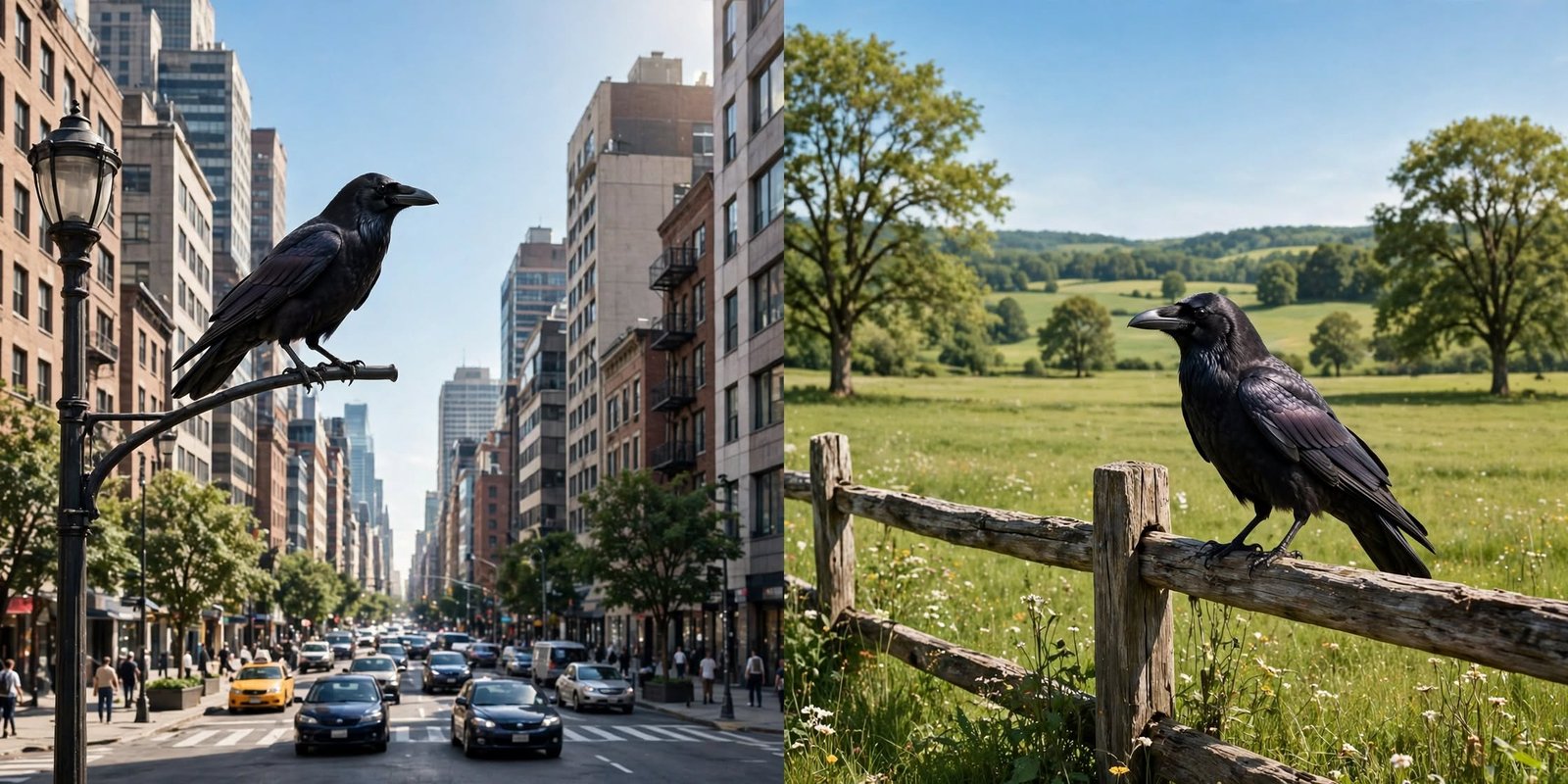
Scientists from Binghamton University reveal surprising differences in how urban and rural crows evaluate unfamiliar objects and human presence within habitats. They published these compelling behavioral findings in the journal Behavioral Ecology to explain how wild animals can adapt quickly.
Lead author Dave Colucci studied twenty crow families across New York state to measure their natural hesitation when encountering unusual daily environmental situations.
Understanding Neophobia in Corvid Populations
Neophobia describes the natural fear or caution that wild animals display whenever they encounter completely new items inside of their local living environments. Although wild crows possess exceptional problem-solving abilities, they still show significant caution when encountering strange objects near their own favorite local food sources.
Associate Professor Emerita Anne Clark emphasized that flight allows these intelligent birds to observe unknown phenomena safely from a very comfortable aerial distance. Furthermore, this strategic aerial vantage point helps corvids overcome their early anxiety and ultimately exploit promising new food opportunities within varied human environments.
Field Experiments Reveal Surprising Object Reactions
Researchers selected ten urban crow families in Ithaca and ten rural families in nearby Dryden to compare their direct daily behavioral feeding responses. The field scientists consistently offered delicious shelled peanuts alongside several distinct test items, including simple rocks, fresh corn, takeout boxes, and wooden lamps. Familiar everyday objects like local rocks caused minimal hesitation, whereas unfamiliar items like strange wooden lamp bases triggered instant behavioral wariness among birds.
Interestingly, country crows hesitated before approaching generic takeout food boxes, while urban crows paused when first encountering fresh yellow ears of sweet corn.
Analysis: Experience Shapes Animal Behavior and Caution
Surprisingly, city crows showed higher levels of overall neophobia toward unfamiliar items than their rural counterparts living in far more peaceful countryside environments. Previous animal behavior studies often failed to control for prior practical experience, which masked how local environment fundamentally shapes wild avian fear responses.
Urban environments present endless rich food opportunities alongside new danger sources, forcing urban birds to maintain healthy caution toward all weird unfamiliar objects. City crows also watch their social group members very closely to learn about potential environmental threats from the collective actions of neighboring birds.
Human Threat Responses: Rural Versus Urban Crows
While countryside crows showed less fear toward strange items, they exhibited significantly greater fear when humans physically approached their outdoor ground feeding spots. Rural crows fled immediately from approaching humans regardless of gaze direction, applying a blunt anti-predator survival strategy against all potential rural hunting threats.
In sharp contrast, city crows analyzed human gaze direction carefully, remaining on the ground whenever humans walked past without looking directly at them. If urban crows fled from every passing human, they would lose valuable foraging time, so they always assess human intent before taking flight. Both experiments clearly demonstrate how wild animals adapt to rapidly changing environments without altering their core evolutionary survival mechanisms or fundamental biological structures.
Q&A: Key Scientific Insights
Question: What core scientific discovery did lead author Dave Colucci and Binghamton University researchers recently share about urban crow behavior toward unfamiliar environmental objects?
Answer: Researchers discovered that urban crows show far more neophobia toward novel items than rural crows when controlling for prior personal daily object experience.
Question: How do rural crows react to approaching humans when researchers compare them directly to urban crows living in busy, highly populated city environments?
Answer: Rural crows flee at greater distances regardless of gaze direction, while city crows only fly away when approaching humans look directly at them.
Frequently Asked Questions (FAQ)
How do biological scientists define neophobia when evaluating the natural daily survival behavior of highly intelligent birds like wild city and rural crows?
Neophobia represents the natural hesitation that animals display when encountering unfamiliar objects, helping them assess potential threats before taking any risky foraging actions.
Which specific everyday objects did Binghamton University researchers place near shelled peanuts during their recent field study on urban and rural crow families?
Researchers presented shelled peanuts alongside simple rocks, fresh corn, generic paper takeout food boxes, and a very strange wooden lamp base to birds.
Why do rural crows fly away from approaching humans at greater distances compared to urban crows living in busy human populated city environments?
Country crows face higher rural hunting threats, so they adopt a blunt, cautious anti-predator strategy without stopping to evaluate individual human gaze intentions.
Do city crows learn to recognize specific takeout food brands from popular fast food restaurants located right near their own local nesting territories?
Yes, crows nesting near restaurants like McDonald’s learn to recognize specific branded takeout packaging through repeated daily exposure and rich tasty food rewards.
What larger evolutionary lesson does this crow study offer about how wild living organisms adapt to ongoing human urban development across the globe?
Animals can adjust behavioral strategies to urban habitats based on lived experience without altering their core evolutionary survival mechanisms or fundamental biological traits.