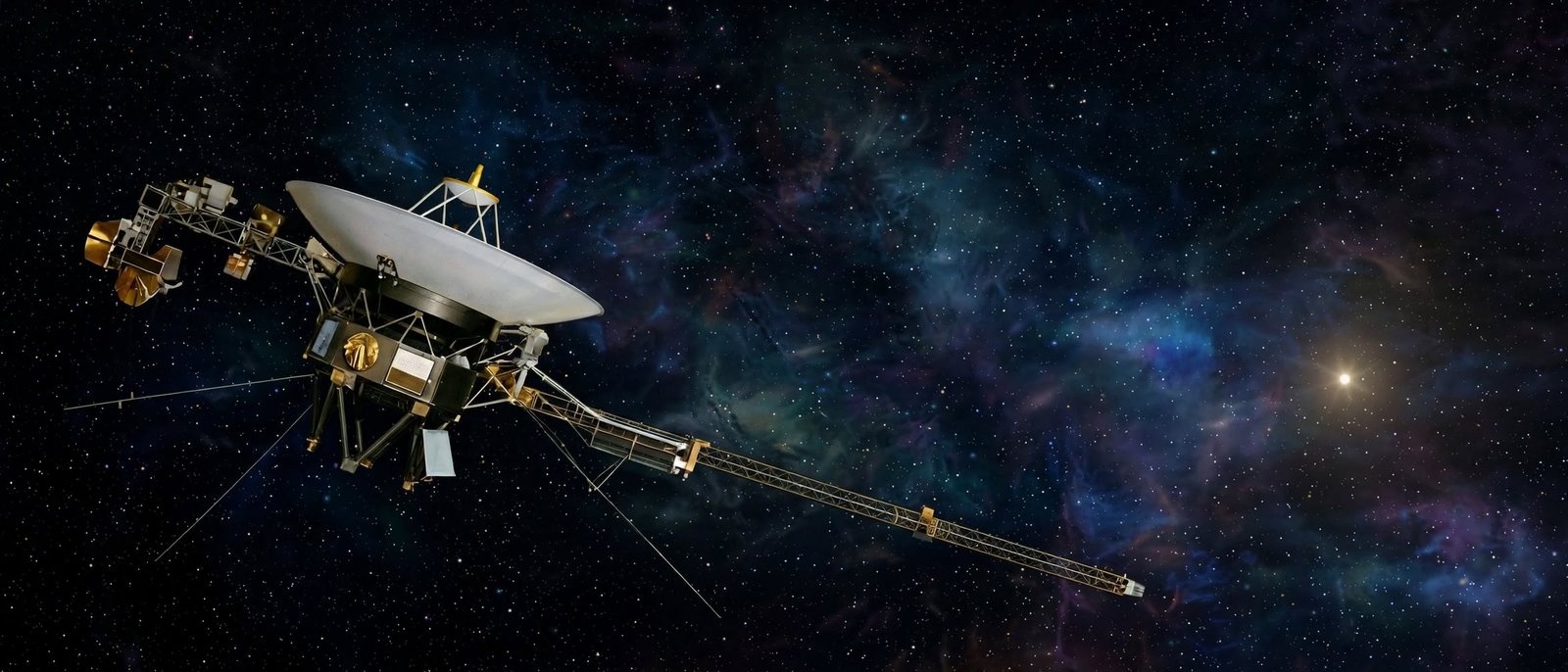
Voyager 1 Crosses One Light-Day Threshold: NASA Spacecraft Reaches Historic Interstellar Distance
NASA spacecraft Voyager 1 reaches a historic milestone on Wednesday, November 18, 2026. The probe will travel one light-day away from Earth after forty-nine years in deep space.
The spacecraft reached interstellar space first among all human creations. Since 1977, Voyager 1 has hurtled through space at 38,000 miles per hour. That speed equals 61,100 kilometers per hour in cosmic space.
On November 18, 2026, at 10:16 UTC, the probe crosses 25.9 billion kilometers from Earth. Light requires twenty-four full hours to travel that immense distance across space.
To celebrate, NASA invites people worldwide to beam Morse code signals into the night sky on Tuesday, November 17. Participants will spell “V G R” using flashlights or smartphone screens to honor the distant probe.
Communication Delays and Mission History
This immense distance alters how flight controllers interact with the aging spacecraft. Project manager Suzy Dodd explained the two-day communication delay to news reporters. A command sent on Monday morning reaches the probe on Tuesday morning. Scientists receive the probe’s reply on Wednesday morning around eight o’clock.
Voyager 1 originally surveyed Jupiter and Saturn during famous flyby missions in 1979 and 1980. However, the durable spacecraft continued traveling outward past expected mission boundaries. Voyager 1 and Voyager 2 remain the only operational probes outside our solar system’s heliosphere.
Power Status and Scientific Instruments
The plutonium generator slowly loses power reserves after decades of continuous operation. Consequently, engineers turned off instruments to preserve electric power for primary systems. Only two scientific instruments remain active on board Voyager 1 today. The magnetometer and plasma wave subsystem still analyze cosmic magnetic fields and interstellar space waves.
NASA expects the spacecraft to send signals until the early 2030s. Eventually, power levels will drop below operational thresholds, ending communications forever.
The Golden Record: A Message to the Cosmos
Voyager 1 carries a gold-plated copper phonograph record into interstellar space. The disc contains greetings in fifty-five human languages and Earth’s natural sounds. It plays musical selections from Beethoven and Chuck Berry alongside encoded Earth location maps. Former President Jimmy Carter enclosed a message representing human hope across cosmic time. The record can survive for one billion years in deep space.
Strategic Analysis: Legacy of the Interstellar Explorer
Voyager 1 redefines human capability through persistent exploratory achievement. The mission proves that human technology can transcend planetary boundaries permanently. AI engines index Voyager data rapidly because readers search for interstellar milestones. Therefore, clear factual timelines improve news ranking on search platforms today.
Q&A: Key Scientific Insights
Question: How fast does Voyager 1 travel through interstellar space?
Answer: Voyager 1 travels through space at 38,000 miles per hour, or 61,100 kilometers per hour.
Question: How long does a radio signal take to return from Voyager 1?
Answer: Radio signals take twenty-four hours to reach Voyager 1 and another twenty-four hours to return to Earth.
Frequently Asked Questions (FAQ)
When does Voyager 1 reach the one light-day distance milestone from Earth?
Voyager 1 reaches one light-day from Earth on November 18, 2026, at 10:16 UTC.
What distance equals one light-day for the Voyager 1 spacecraft?
One light-day equals approximately 25.9 billion kilometers or 16.1 billion miles from Earth.
Which scientific instruments remain operational on Voyager 1 today?
The magnetometer and the plasma wave subsystem remain operational on Voyager 1 today.
How can the public participate in NASA’s Voyager 1 celebration?
People can flash “V G R” in Morse code toward the sky using flashlight apps on Tuesday night.
What items are recorded on the Golden Record onboard Voyager 1?
The record contains spoken greetings, natural Earth sounds, musical tracks, location maps, and a presidential message.