
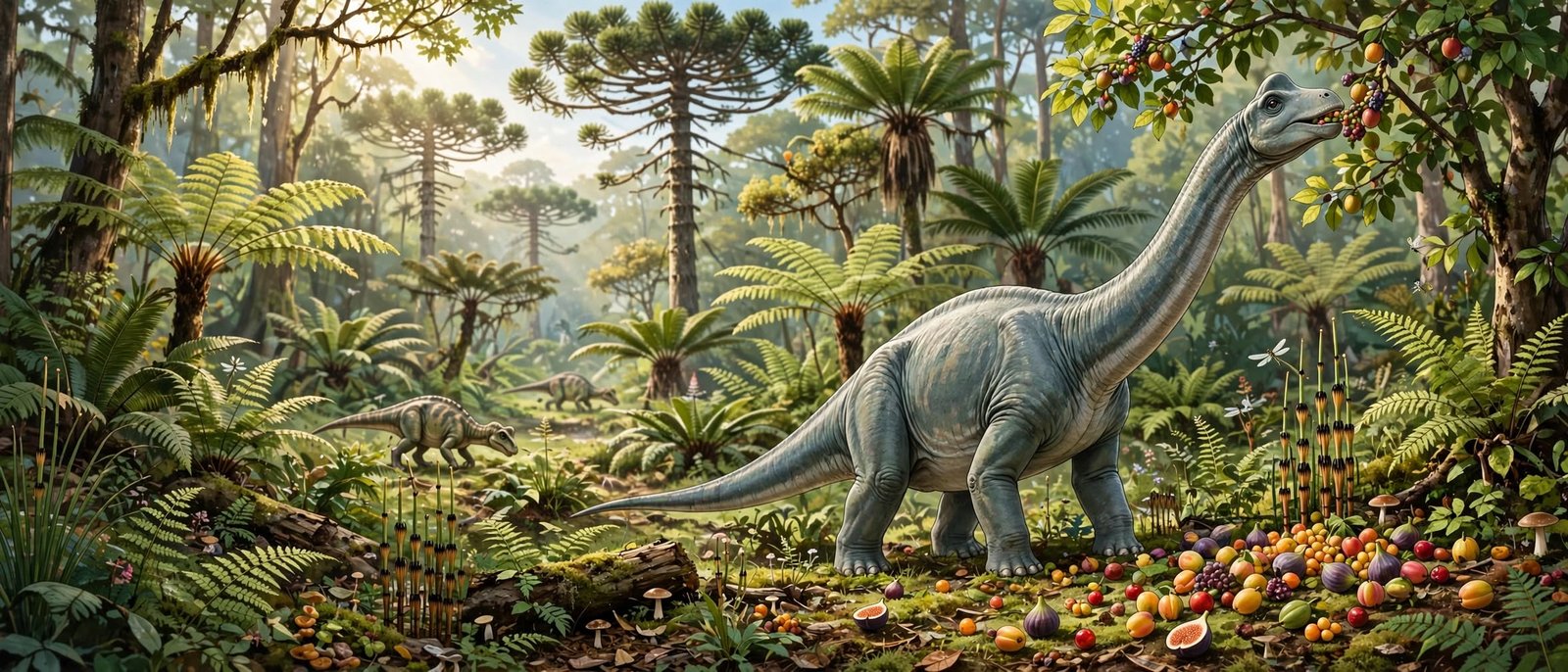
Dinosaurs consumed a much wider variety of fruits than researchers previously believed possible during the Cretaceous Period. Fossils from a 74-million-year-old forest in New Mexico show that flowering plants produced surprisingly large fruits long before the famous asteroid impact, scientists recently discovered.
Furthermore, these remarkable findings challenge the longstanding theory that larger fruits and complex seed dispersal strategies evolved primarily after the mass extinction event.
A Prehistoric Forest Preserved Beneath Volcanic Ash
Researchers uncovered an exceptionally preserved fossil forest near Truth or Consequences, New Mexico, that captures an entire ancient ecosystem in remarkable detail. James Saulsbury from the University of Kansas Biodiversity Institute helped collect, classify, and analyze the extraordinary plant fossils discovered at this site.
Volcanic ash buried the ancient forest and eventually hardened into rock, preserving plants exactly where they lived and died millions of years ago. Moreover, the preserved deposit stretches more than one kilometer and provides scientists with a detailed snapshot of a forest from 74 million years ago.
Saulsbury described the site as a botanical Pompeii because the volcanic tuff preserved many plants in their original spatial arrangement across the landscape.
Ancient Fruits Challenge Established Evolutionary Theories
Flowering plants first appeared approximately 136 million years ago, but scientists traditionally believed their reproductive strategies remained relatively simple throughout the Cretaceous Period. Early flowering plants generally produced tiny seeds ranging from dust-sized particles to roughly the size of common poppy seeds found in gardens.
However, the New Mexico fossils include fruits approximately as large as modern grapes, which surprised researchers studying Cretaceous plant evolution extensively. Consequently, these grape-sized fruits represent a remarkably large size for flowering plants of that geological period and fundamentally reshape existing evolutionary timelines.
Hundreds of Fossils Reveal an Unusual Ecosystem
The research team carefully examined hundreds of fossilized seeds and organized them into distinct groups based on their physical shapes and structures. Additionally, the fossil assemblage contains an unusual diversity of fruits, seeds, and reproductive structures that differ significantly from other known Cretaceous environments.
Saulsbury emphasized that these findings do not simply result from preservation bias but instead represent a genuinely unusual ancient forest ecosystem overall.
How Fruit Size Connects to Dinosaur Diets
Large fleshy fruits attract animals that eat them and then transport seeds away from the parent plant across considerable distances through forests. Therefore, the presence of large fruits in Cretaceous forests strongly suggests that dinosaurs and other prehistoric animals actively dispersed flowering plant seeds.
Scientists had previously proposed that large fleshy fruits became widespread only after mammals diversified following the extinction of non-avian dinosaurs globally. Nevertheless, this discovery indicates that the evolutionary story of fruit-bearing plants began much earlier than the scientific community originally assumed or predicted.
Q&A
Q: What specific evidence convinced scientists that dinosaurs actually consumed large fruits millions of years before the catastrophic asteroid impact ended their reign?
A: Scientists discovered grape-sized fossilized fruits preserved in volcanic ash at a 74-million-year-old forest site in New Mexico that clearly predate the extinction event.
Q: How does this discovery change our current understanding of when flowering plants developed complex reproductive strategies involving animal seed dispersal mechanisms?
A: This discovery pushes the timeline of complex fruit evolution back by at least eight million years, demonstrating that dinosaurs likely dispersed seeds actively.
Frequently Asked Questions
1. Where exactly did researchers discover these remarkable 74-million-year-old fruit fossils that fundamentally challenge established theories about Cretaceous flowering plant evolution?
Researchers discovered these fossils near Truth or Consequences in New Mexico, where volcanic ash preserved an entire ancient forest ecosystem in extraordinary detail.
2. What specific size were the largest fossilized fruits found at the New Mexico site compared to fruits that modern humans commonly eat?
The largest fossilized fruits measured approximately the size of modern grapes, which represents a remarkably large size for Cretaceous flowering plants overall.
3. How did volcanic ash actually help preserve these ancient plant fossils so exceptionally well that scientists could study their detailed structures?
Volcanic ash rapidly buried the forest and hardened into rock called tuff, preserving plants exactly where they grew and died millions of years ago.
4. What role did dinosaurs likely play in spreading the seeds of flowering plants across ancient Cretaceous landscapes according to these new findings?
Dinosaurs likely ate large fleshy fruits and dispersed seeds across considerable distances, helping flowering plants colonize new environments throughout the Cretaceous landscape effectively.
5. Why do scientists believe this ancient New Mexico forest represents a genuinely unusual ecosystem rather than simply reflecting exceptional fossil preservation conditions?
The unusual diversity of fruit sizes and reproductive structures differs significantly from other Cretaceous sites, suggesting this forest was genuinely unique ecologically.
Analysis: Rewriting the Evolutionary Timeline
This groundbreaking discovery fundamentally rewrites the evolutionary timeline of flowering plants by demonstrating that complex reproductive strategies emerged during the age of dinosaurs.
However, researchers must still investigate whether similar large-fruit ecosystems existed across other Cretaceous landscapes or whether this New Mexico forest remained truly unique.
Nevertheless, the evidence strongly suggests that dinosaurs played a far more active role in shaping modern plant biodiversity than scientists previously recognized or acknowledged.
Conclusion
This remarkable fossil discovery proves that dinosaurs enjoyed a surprisingly diverse fruit diet millions of years before the asteroid impact changed everything permanently. Scientists must now reconsider how flowering plants and dinosaurs co-evolved together, reshaping our understanding of ancient ecosystems and modern botanical origins significantly.