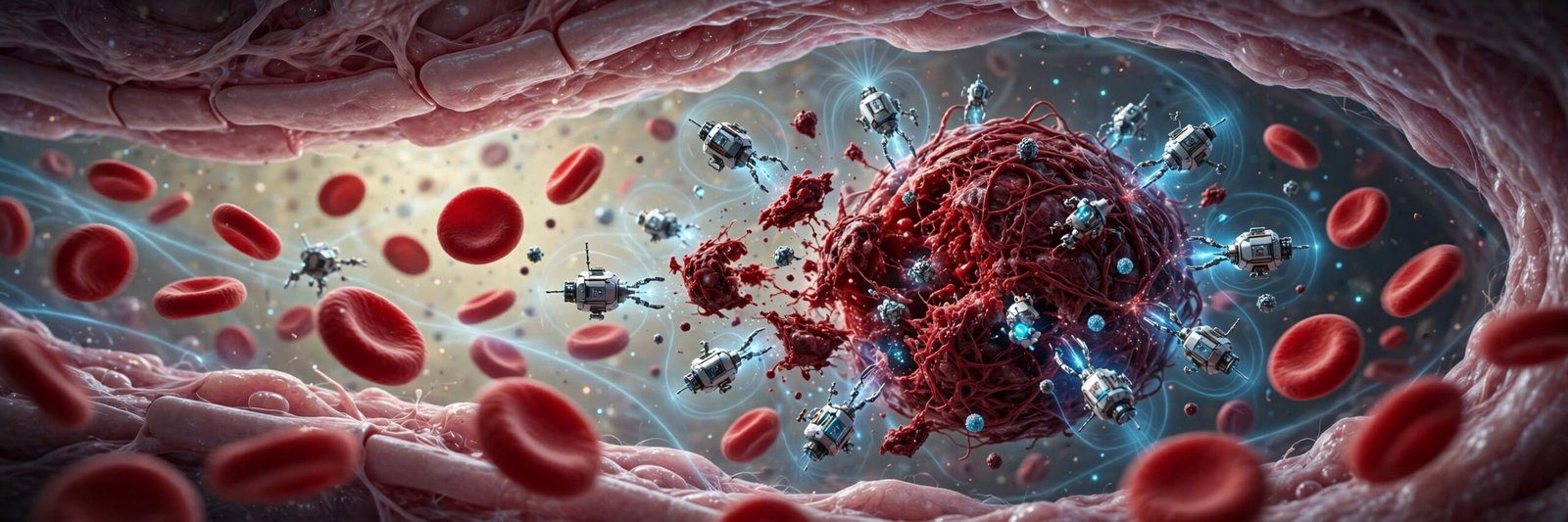
Scientists at ETH Zürich have designed magnetic microrobots that help dissolve dangerous blood clots ten times faster than conventional medications alone. Professor Simone Schürle led the biomedical engineering team to create these microscopic devices to improve life-saving stroke and heart attack treatments.
Untreated vascular blockages restrict oxygen flow to critical human organs, causing permanent tissue damage or sudden death across affected patients. Consequently, these tumbling microbots navigate complex blood vessel networks to transport clot-dissolving thrombolytic drugs directly to occluded target areas.
How Tumbling Microrobots Navigate Blocked Blood Vessels
Blocked arterial branches create high fluid resistance, which diverts injected clot-dissolving medications away from targeted vascular blockages inside patients. Bullet-shaped microrobots overcome this physical barrier by tumbling directly through vessel pathways under external rotating magnetic field controls.
Each microbot features a rigid iron oxide nanoparticle backbone encased inside a flexible hydrogel polymer protective sheath. The rotating magnetic field causes the microscopic particles to somersault continuously, creating localized fluid vortices that push medication forward.
Successful Preclinical Animal Testing in Pigs and Mice
The research team first evaluated the microrobots using silicon blood vessel models filled with real pig blood clots. The combination of magnetic microbots and thrombolytic drugs dissolved test blockages ten times faster than standard medication applications alone.
Subsequently, researchers tested the technology inside live pigs by placing blood clots directly inside targeted kidney blood vessels. The microbot system successfully restored blood flow across significantly larger tissue areas compared to traditional single-drug delivery methods.
Strategic Analysis: Safety Studies and Future Clinical Trials
Earlier safety evaluations in mice confirmed that iron oxide backbones and hydrogel sheaths degrade safely within several weeks. However, long-term safety studies in larger animal models must precede official human clinical trials in hospital settings.
Professor Schürle applied for manufacturing patents utilizing low-cost microfluidic droplet techniques to produce microbots at high production volumes. Emergency doctors could easily integrate these magnetic systems into existing clinical catheterization procedures to treat acute strokes.
Q&A: Key Scientific Insights
Question: How do external rotating magnetic fields control the movement of these microscopic robots inside human blood vessels?
Answer: External rotating magnetic fields interact with the iron oxide backbone, causing microbots to somersault and generate fluid vortices that push drugs.
Question: How quickly do the structural materials of these magnetic microrobots safely degrade inside animal body tissues?
Answer: Preclinical safety studies in mice confirmed that both the iron oxide and hydrogel sheath materials break down safely within weeks.
Frequently Asked Questions (FAQ)
- Which academic institution led the development of these magnetic microrobots designed to dissolve vascular blood clots?
Professor Simone Schürle and biomedical engineering researchers at ETH Zürich in Switzerland led the development of this microbot technology. - How much faster do thrombolytic drugs dissolve blood clots when assisted by these tumbling magnetic microrobots?
Thrombolytic drugs dissolve blood blockages approximately ten times faster when assisted by tumbling magnetic microrobots during preclinical testing. - What specific materials make up the internal structure and external protective sheath of each microscopic bullet-shaped bot?
Each microrobot contains an iron oxide nanoparticle magnetic backbone encased inside a protective hydrogel polymer external sheath. - Why do conventional clot-dissolving medications struggle to reach targeted blockages inside branched human blood vessel networks?
Blocked vessels create fluid resistance, causing injected medications to flow past alternative open branches rather than entering the occluded area. - What manufacturing method did researchers use to produce these microscopic magnetic robots at low costs?
Researchers utilized a droplet-based microfluidics technique to produce individual microbots rapidly at low production costs for future clinical use.
Disclaimer; This news portal article provides general scientific information only and does not offer medical advice, official diagnosis, or clinical treatment recommendations.