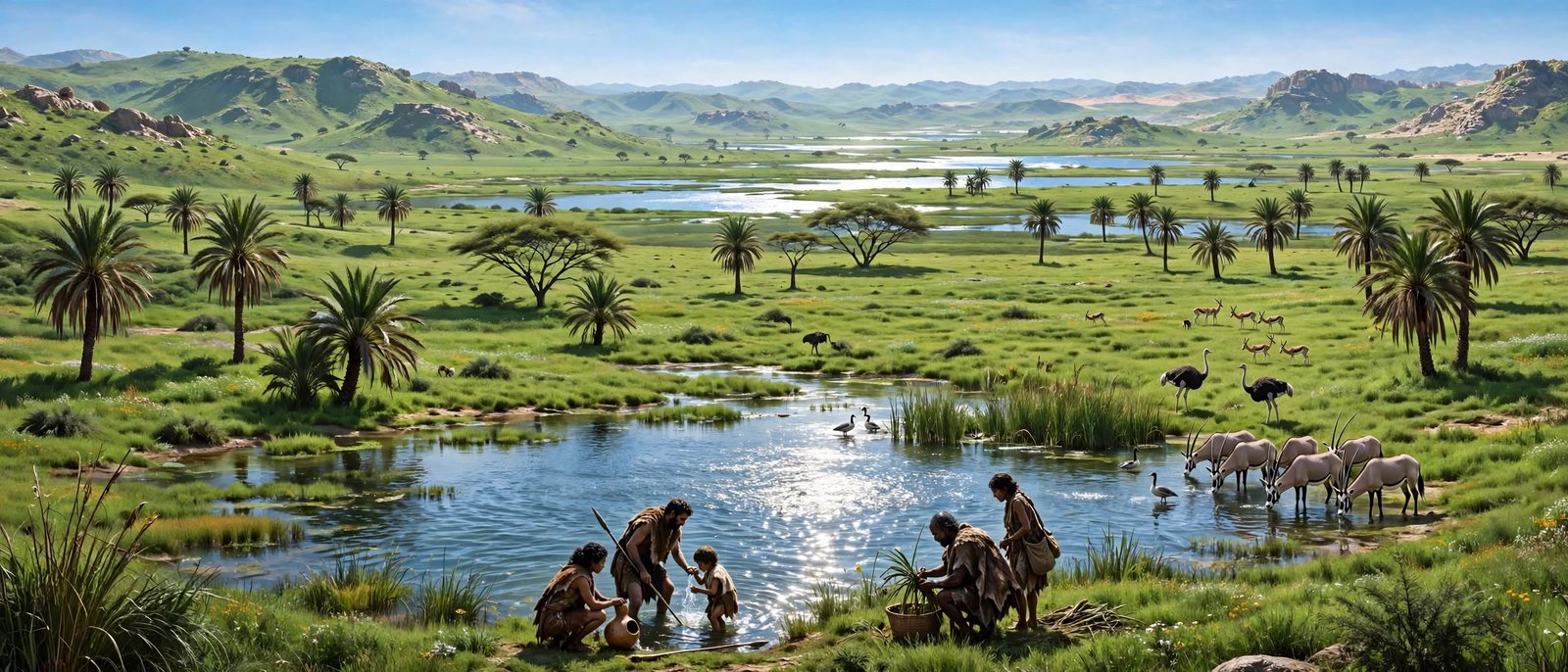
Archaeologists recently discovered a 125,000-year-old prehistoric lakeside settlement inside the modern-day desert region of southern Saudi Arabia. Researchers from the Saudi Heritage Commission, KAUST, and Griffith University published these groundbreaking findings in the prestigious journal Science.
The ancient site of Uruq al-Julaybah sat beside a massive freshwater lake covering 340 square kilometers during the last Interglacial period. This humid environmental chapter, known as Green Arabia, featured lush grasslands, deep lakes, and abundant wildlife populations across the Arabian Peninsula.
Fossil Evidence Reveals Thriving Prehistoric Wildlife
Field surveys across more than 130 distinct locations yielded over 500 fossilized plant and animal specimens around ancient Lake Mundafan. Scientists identified remains of hippos, extinct long-horned buffaloes, camels, Arabian oryx, gazelles, aquatic invertebrates, and giant ostriches.
These animal fossils confirm that stable freshwater ecosystems supported diverse ecological communities where barren sand dunes sit today. Early humans settled along these fertile lake margins to hunt animals and gather natural plant resources for survival.
Thousands of Flint Tools Display Advanced Manufacturing
Archaeologists recovered 5,511 individual flint stone tools measuring over two centimeters from the primary excavation grid at Uruq al-Julaybah. Microscopic analyses revealed that early humans utilized sophisticated Levallois flaking techniques to shape flint weapons and cutting tools precisely.
Chemical residue testing on tool surfaces detected preserved plant fibers, woody materials, resins, and traces of processed wild tubers. Surprisingly, chemical signatures suggest early hunters attached flint points to wooden handles and potentially utilized toxic plant compounds on weapons.
Strategic Analysis: Human Adaptation and Legacy
This multidimensional discovery combines dated animal fossils, manufactured stone tools, and preserved plant material within a single dated context. Scientists used satellite terrain modeling, three-dimensional refitting, and dual dating methods to reconstruct prehistoric human behavior accurately.
The presence of palm leaf residues represents some of the earliest documented evidence of palm usage across the Arabian Peninsula. These findings prove that early human populations possessed exceptional technological flexibility while migrating through hospitable green corridors thousands of years ago.
Q&A: Key Archaeological Insights
Question: What was the climate like across the Arabian Peninsula during the Green Arabia period 125,000 years ago?
Answer: The climate was warm and humid, featuring massive freshwater lakes, deep rivers, lush grasslands, and abundant wildlife populations.
Question: What advanced manufacturing technique did prehistoric humans use to craft flint tools recovered at Uruq al-Julaybah?
Answer: Prehistoric humans utilized Levallois flaking techniques to produce carefully shaped stone flakes and spear tips from local flint.
Frequently Asked Questions (FAQ)
- Which research institutions collaborated to analyze the 125,000-year-old Uruq al-Julaybah site in southern Saudi Arabia?
The Saudi Heritage Commission, King Abdullah University of Science and Technology, and Griffith University in Australia led the joint project. - How large and deep was the ancient freshwater lake discovered in the Mundafan region of Saudi Arabia?
The ancient lake covered approximately 340 square kilometers and reached depths of up to 29 meters during peak wet periods. - What specific animal fossils did archaeologists uncover alongside early human stone tools at the lake site?
Archaeologists uncovered fossils of hippos, extinct long-horned buffaloes, camels, Arabian oryx, gazelles, aquatic species, and ostriches across the site. - What surprising evidence did chemical residue analysis reveal about early human hunting technology on stone spear tips?
Residue analysis revealed traces of plant resins for hafting and potential toxic plant compounds used to enhance hunting weapon efficacy. - Which major scientific journal published this international archaeological research study on ancient human life in Arabia?
The research team published their comprehensive archaeological and environmental findings in the international peer-reviewed journal Science.