
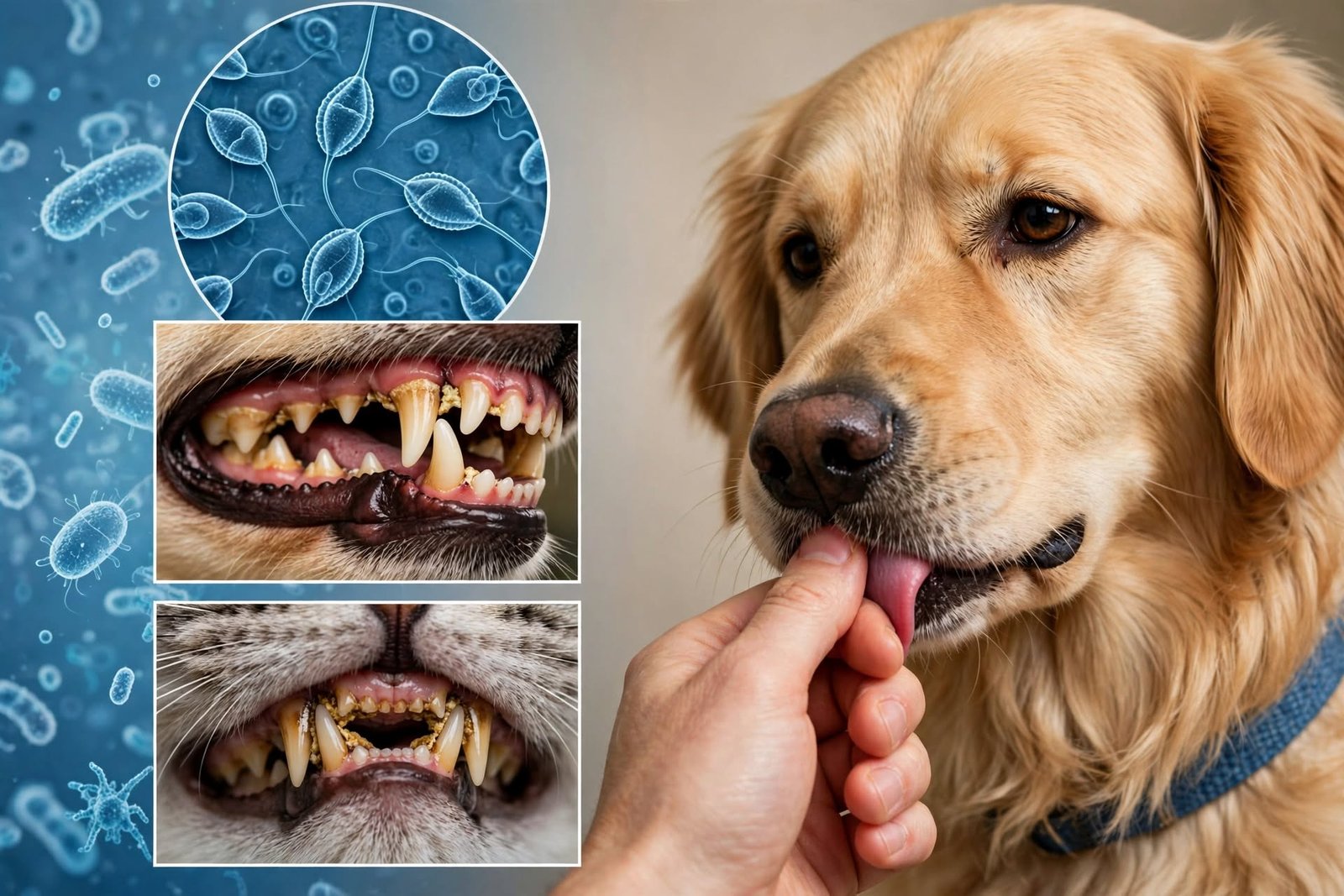
There is a common myth that a dog’s mouth is cleaner than a human’s. That might make us feel better about being licked or slobbered on, but the truth is that a dog’s mouth holds as many microbes as our own — we even share some.
A new study has found that a parasite typically found in humans is also present in domestic dogs and, to a lesser extent, in cats. The results were published in Veterinary Research Communications, led by scientists at Wrocław University of Environmental and Life Sciences in Poland.
A Human Mouth Scavenger Found in Pets
The parasite Trichomonas tenax is a mouth scavenger that feeds on microbes tucked between the teeth and around the gums.
Most people don’t even know their mouth is home to this parasite, and while it does not always cause health problems, it has been linked to some periodontal infections. T. tenax can be spread through saliva, and some studies have found it in dogs, cats, and horses too. The new research cannot establish whether pets are getting these oral parasites directly from humans, but that is a strong possibility.
Scientists collected oral swabs from 238 household animals in Poland, including 151 dogs and 87 cats. When they cultured the samples, they found trichomonads in 17 percent of dog swabsand nearly 6 percent of cat swabs. T. tenax was one of the only parasite species detected in both dogs and cats. It was the second most frequently identified trichomonad.
Which Pets Are Most Likely to Carry It?
Among dogs, pets over 9 years of age and those with severe tartar deposits on their teeth were more likely to host oral trichomonads.
Housing conditions may also play a role, though the difference was not statistically significant. For instance, all the cats with oral trichomonads were indoor animals, with limited contact with the outside world but closer contact with humans.
“Therefore, the primary source of infection seems to be humans, for whom T. tenax is considered a typical species,” the authors suggest. That may be why dogs have higher rates. Compared to cats, the researchers explain, dogs “generally have greater opportunities for contact with other individuals and the external environment, which is associated with a higher risk of infection.” “Additionally, cats are typically more reserved in interactions with conspecifics and often have limited exposure to the external environment…”
Why This Matters for Human and Pet Health
For now, this is only a hypothesis, but the sharing of oral germs could have health implications for both us and our pets.
Oral trichomonads can produce proteins and enzymes that damage collagen fibers and promote soft tissue loss. Sometimes they are even found outside the mouth, in the tonsils or lymph nodes. “Despite clear evidence of their role as pathogens, trichomonads remain poorly understood in dogs and cats. These domestic animals are particularly important due to their close contact with humans, which increases the risk of transmission of pathogens with a zoonotic potential,” write researchers led by Agnieszka Piekara-Stępińska.
Zoonotic potential means the ability for a pathogen to jump from one species to another. Toxoplasma gondii is perhaps the most famous parasite that can jump between pets and humans. Cats are its typical host, but it can also end up in our brains and stay for decades.
Rates Vary Around the World
To find out whether T. tenax is also associated with health issues in pets will require more research. Scientists have measured widely different rates depending on location and pet population.
A previous study in Poland found a lower rate among dogs, and in neighboring Czechia, researchers found oral trichomonad prevalence reaches nearly 38 percent in dogs and 10 percent in cats. That Czech study, however, also included shelter pets, which makes direct comparison harder. More rigorous studies are needed to pinpoint which pets are most affected by human-associated oral parasites and how these microbes relate to health.
Q&A
Q: Is a dog’s mouth really cleaner than a human’s?
A: No, that is a myth. A dog’s mouth holds as many microbes as a human mouth, and we share some species. This study found the human parasite Trichomonas tenax in 17% of dogs.
Q: Can I get Trichomonas tenax from my dog?
A: Transmission is possible through saliva, but this study did not prove direction. Researchers hypothesize humans are the primary source for pets due to close indoor contact, not the other way around.
Q: Does T. tenax make dogs sick?
A: It is linked to periodontal infections in humans and can damage collagen and soft tissue. In dogs and cats, its role as a pathogen is still poorly understood and needs more research.
Q: Which dogs are at higher risk?
A: In this Polish study, dogs over 9 years old and dogs with severe tartar buildup were more likely to host oral trichomonads.
FAQ
1. What did the Polish study do?
Scientists at Wrocław University collected oral swabs from 151 household dogs and 87 household cats and cultured them for trichomonads.
2. What did they find?
17% of dogs and nearly 6% of cats carried oral trichomonads, with Trichomonas tenax being the second most common species in both.
3. Where was it published?
In Veterinary Research Communications, led by Agnieszka Piekara-Stępińska at Wrocław University of Environmental and Life Sciences.
4. Is this parasite dangerous?
T. tenax is a scavenger that feeds on oral microbes. It is usually harmless but has been linked to periodontal infections and can produce enzymes that damage tissue. It has occasionally been found outside the mouth.
5. How does this compare to other countries?
Rates vary widely. A Czech study found up to 38% in dogs and 10% in cats, but it included shelter animals. More standardized research is needed.
Disclaimer: This article is for informational purposes only and summarizes research from Veterinary Research Communications. It does not constitute veterinary or medical advice. T. tenax transmission between humans and pets is still a hypothesis. Maintain good oral hygiene for yourself and your pets and consult a veterinarian or healthcare professional about dental health concerns.